
|
We still have seed of AAC Yellow 80 composite yellow mustard (if we get an average year or on irrigation it is the yellow to grow) and GS Dunn at Bow Island has contracts available, email: Blaine at blaqua@gsdunn.com .
For mustard seed contact Blair Balog at 403-634-4349 (call or text) or blair@stampseeds.com
0 Comments
Chuck Penner of LeftField gave an all crop outlook on January 11th, 2024 at the Sask Mustard AGM in Saskatoon.
Chuck Penner of LeftField showed this crop returns comparison and scorecard ranking crops net returns on January 11th, 2024. Chuck Penner of LeftField gave a mustard crop market outlook January 11th , 2024 at the Sask Mustard AGM in Saskatoon. Supplies of mustard are larger this winter due to larger acres grown in Canada in 2023. The USA is growing more mustard (mainly yellow) so that may limit yellow sales from Canada to the USA and limit pricing. Chuck is thinking aces will be down 17%, I think its possible that they do go down a little as there are less contracts available this season but, I don't think it will be that much due to the fact that if crop insurance coverage kicks in, due to drought it may still pencil out ok vs. other crops and weather will play a big factor in next years pricing and anticipated 24/25 mustard supplies. I was able to go to the Sask Mustard AGM and learn about new varieties, and research work in mustard. There is plans for a non GMO Clearfield oriental mustard so you would be able to control canola volunteers in it as well as some weeds. A new hybrid brown is also coming called AAC Brown Elite with similar or better yields to AAC Brown 18 but milling characteristics similar to Centenial brown. Irrigation reservoir levels as of Jan 1st 2024 compared to 2001 another low water level season. Snowpack and spring rains will play a large part of how this season finishes off. The image is courtesy of Will Muller, keep in mind most districts have expanded irrigated acres changed reservoir sizes and crop types and water use intensity. 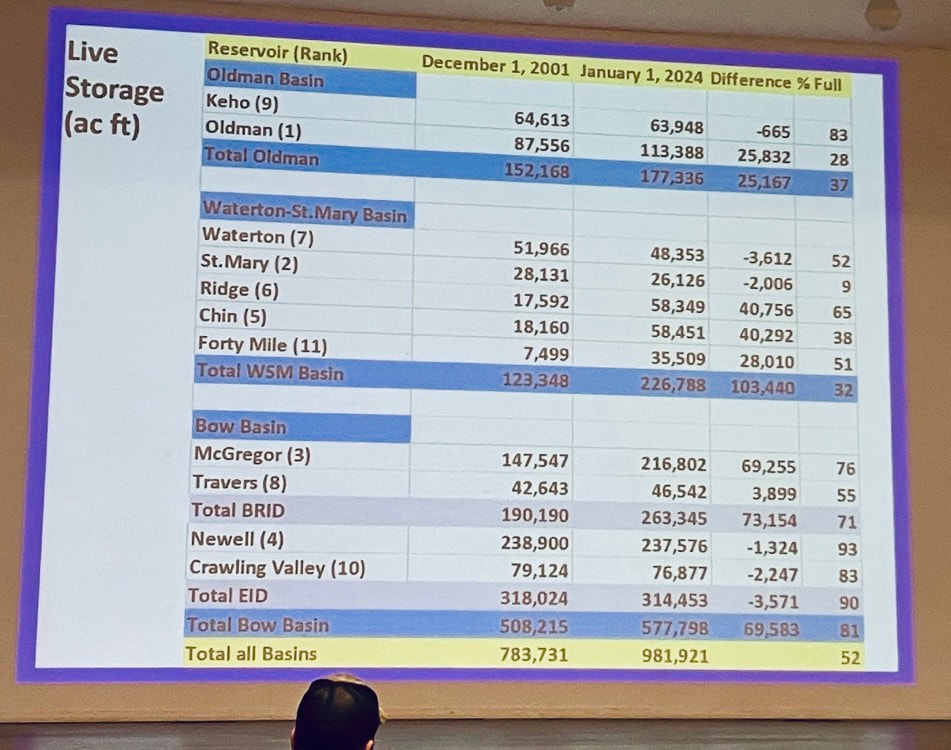 Last season we tried Winterberry winter pea but it did not survive the winter (it was a though winter for other fall crops as well). The peas got quite big last season and had tillers growing as large as the main stem which may have hurt it over winter. This season we are trying Winterberry again and they are smaller going into winter as you can see in the picture above. with tillers just starting. The goal of trying winter peas would be to change water use patterns allowing for bigger yields per unit of water or rain as well as have a crop that rotates well with winter crops allowing similar times of water use and or a silage blend companion. We do see a lot of nodules in the fall but the picture up top doesn't show the nodules well. 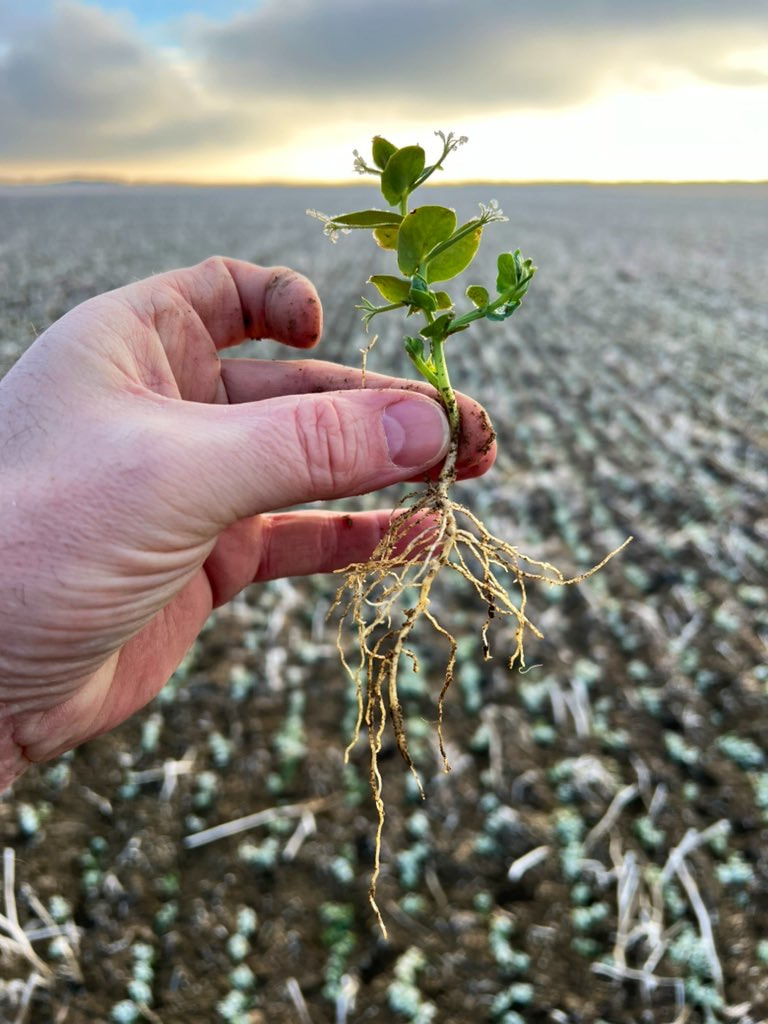 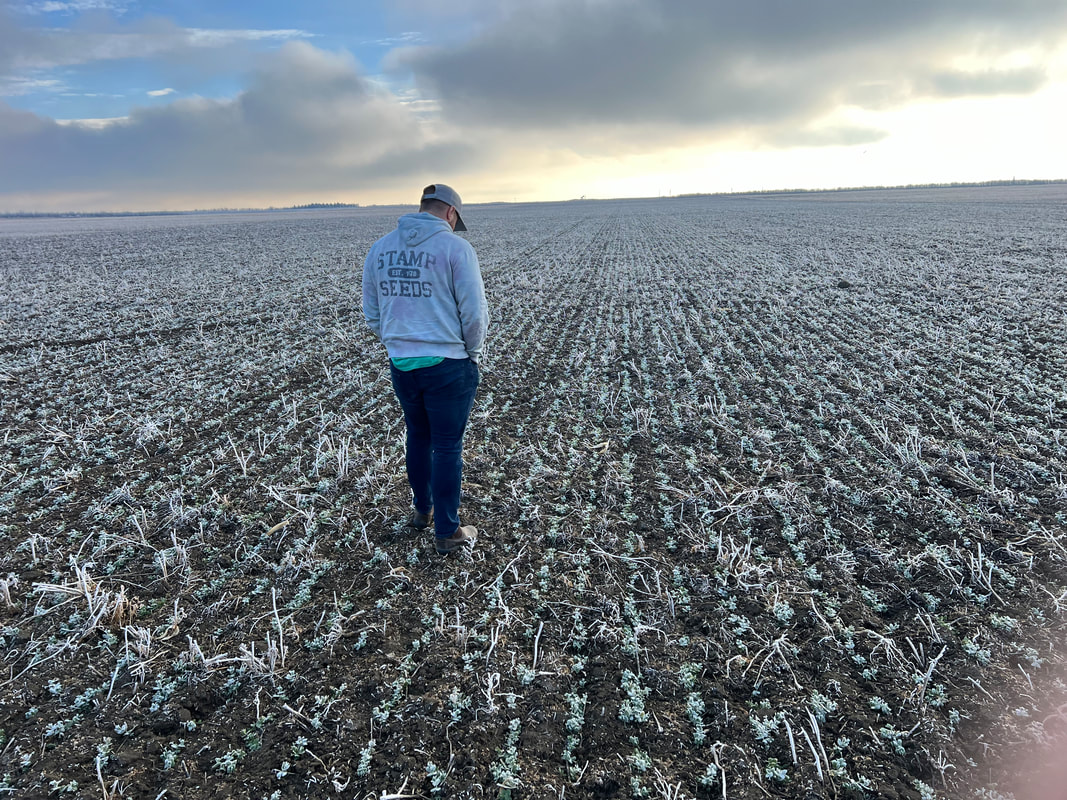 We dug some plants from our demo plots on January 2nd since it was not frozen yet. These were seeded on Sept 20th and it was amazing to see the root difference between these 3 winter cereals. Rye plants are considered scavengers of moisture and fertility and looking at this picture you can see why. Fall crops and rye and triticale specifically can help you achieve more yield per unit of water. More details on hybird fall rye water use and agronomy https://www.stampseeds.com/hybrid-fall-rye.html 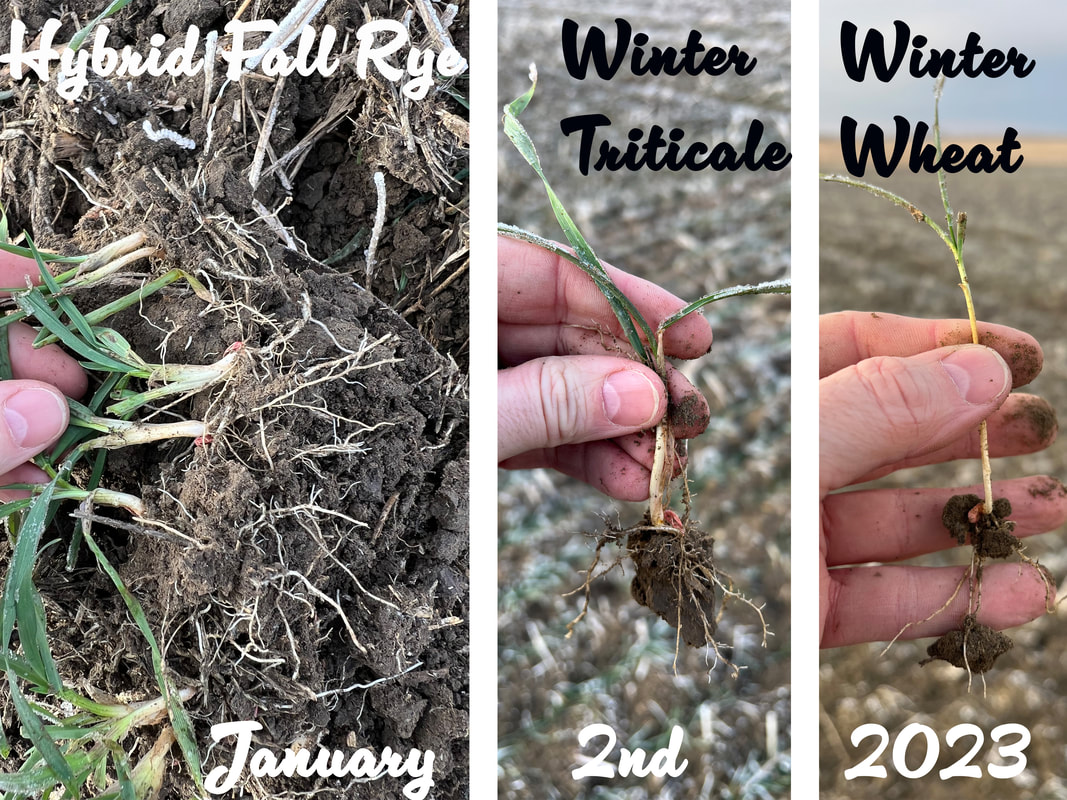 Marlene Boersch of Mercantile Consulting Ventures Inc via Saskatchewan Pulse Growers has a post about the Statistics Canada's adjustment of 2023 pea supply up 15% and lentils 8%! The trade / consultants had anticipated these yield numbers so I don't think it will impact prices much but does say something for StatsCan numbers... Details here: https://saskpulse.com/resources/outlook-for-canadian-peas-lentils/?utm_source=twitter&utm_medium=social-organic&utm_campaign=market-report 
The newly launched service for mental health is here: https://www.agknow.ca
If you or someone you know needs help, this is a farming specific resource to connect with. The Herbert Grain Ventures blog is a regular for me. This post talks about the main things they live by when managing a farm from looking at the big picture, being clear on the direction and how you want to achieve that direction or goal, bringing solutions when you bring a problem, and comments on staying out of the way :) :
Post 1: https://hebertgrainventures.com/paradigm-shifts-5-sayings-on-the-farm-that-have-changed-the-way-we-do-business/ Post 2: https://hebertgrainventures.com/paradigm-shifts-part-two-5-sayings-we-live-by-on-the-farm/ Dr Brian Beres & other researchers & team have some interesting results from ultra early seeding showing generally positive results from seeding spring wheats in the winter to take advantage of speeding up the season for disease, water needs, and yields. Here is a link to his presentation he gave at our event at Ag Expo last winter: https://www.stampseeds.com/blog/ultra-early-seeding1161535 One main question I/others have asked is when and where to test temperature and he says at 2” depth mid morning. One you are at 0 C or above its go time for his research. High plant populations and seed treatments are key as well. Grain News Article: https://www.grainews.ca/features/get-a-head-start-on-the-season-with-ultra-early-seeding/ 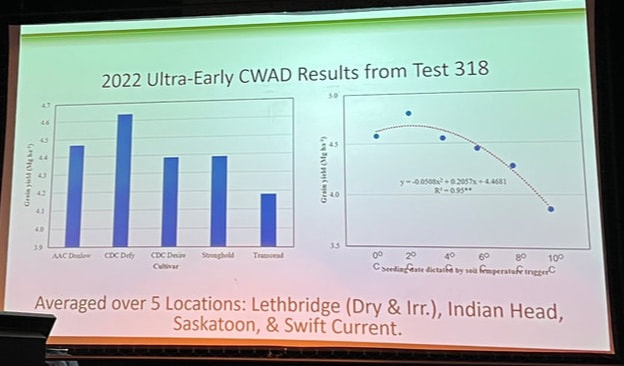 The RVT trials charts are posted online now from the 2023 season.
I use these as a benchmark or comparison when choosing varieties. But don't be fooled as your management style and environment can make a 98% of check variety perform at 118% of check (we saw this in the 2023 season on SY Manness CWRS). These are averages over multiple years and sites so the information is good, just be aware there are many factors that go into the yields you see on your farm. Cereals: https://www.seed.ab.ca/variety-data/cereals/ Flax: https://www.seed.ab.ca/variety-data/flax/ Silage: https://www.seed.ab.ca/variety-data/silage/ Pulses: https://www.seed.ab.ca/variety-data/special-crops/ Blair has prices on TriCal Surge Spring Triticale a new smooth awn triticale. It is a tall variety with lots of material so if growing on irrigation I would suggest a PGR. I feel like water use can be lower on a triticale for silage vs. a soft wheat because it has a more fibrous root system for scavenging and it is taken for silage at milk stage vs. dough stage. Seed can not be farm saved on TriCal Surge. Contact Blair Balog at 403-634-4349 (call or text) or blair@stampseeds.com for pricing or for any questions! 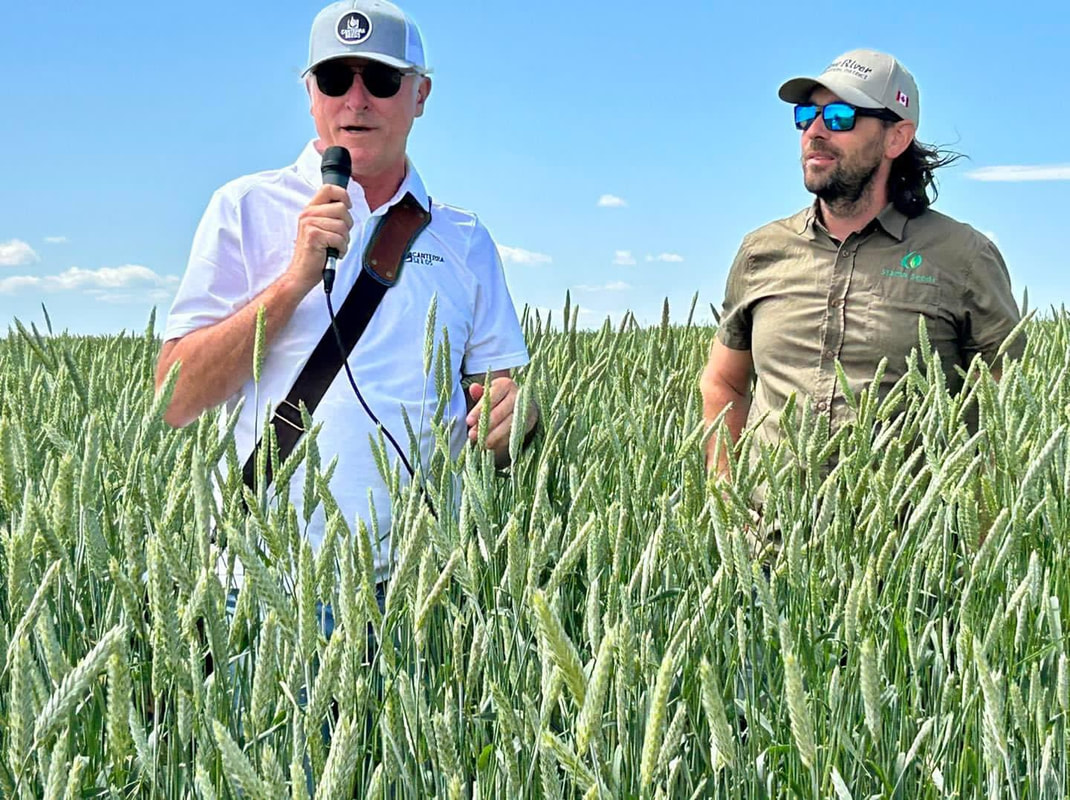 Bookings have been strong in the past few months, here are some trends we are seeing right now:
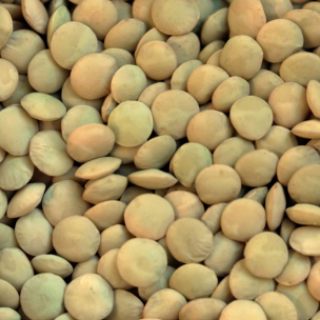 Here is a blog post from https://durodisicilia.wordpress.com/2023/12/31/francesco-casillo-sulle-prospettive-del-mercato-al-2024-ed-oltre/ that was originally in Italian that i used translate to post in English below.
Generally it looks like they think durum production will rise putting pressure on prices. Posted on December 31, 2023 by Granduro Dear friends, in this post our interview with Francesco Casillo, a well-known Italian importer/exporter and miller, with whom I often exchange valuable thoughts on the durum wheat market. In this phase of the break of the campaign I asked him to publicly take stock of the market situation, answering a series of questions asked by me and some readers (who sent them to me in the previous days as per the notice published on the post). I thank him very much for the passionate participation he has dedicated to us and for the beautiful words spent on the blog and for my analyses (but the infallibility is not guaranteed, as for the weather forecast these are probabilistic and ever-changing scenarios). I hope that this (sincere) dialogue between subjects in the supply chain, sometimes with opposing interests, can prove to be profitable and interesting for those who approach the durum wheat market in a non-ideological and corporate way. I see it as a further small piece to try to understand, together, the huge mosaic of the market (of durum wheat and beyond), in such a way as to make the most conscious, thoughtful and appropriate professional choices both in the short and long term. I am pleased to answer the questions that my kind friend Francesco sent me. However, I cannot, not take the opportunity to congratulate the blog for the level of analysis achieved which, believe me, is of the highest level and that so many professional operators in this sector remotely have. From Turkey and Russia, until the end of the campaign, how much grain do you expect to be exported to the world? 300/400 k tonnes could still come out of Turkey on paper. There are rumors that a Tmo (Turkish state body that regulates the Turkish domestic market) may soon come out, but in Turkey there are never certainties and often decisions taken by state bodies are suddenly annulled or changed. Surely if this market indiscretion were to materialize, the quantity sold would cover the needs of Tunisia until a new harvest. As for Russian durum wheat, export was banned until June 2024 and therefore, except for a few previously married cargo on Baltic ports (max 30/40k tm), hard wheat will not be loaded into Russia in the next 6 months. Turkey and Russia new competitors, how do you see them in perspective in the coming years? As aggressive as in this campaign? We are in a globalised market. A free market. It is therefore clear that those who have the availability of wheat or the need for valuable currency act for their own account in the market. Keep in mind that in Russia and Turkey the margins of origination are very high (what exporters earn after paying farmers and logistics costs) and therefore as soon as the wave of speculative farmers' sales arrives, exporters overturn it on international markets making big gains. The higher the spread between hard and tender the stronger the sales flow of farmers who are pretty happy to sell at prices in some cases double those of tender even if a better knowledge of the market would suggest better time management of sales. In perspective, do you see other possible new durum wheat exporting nations on the horizon? The last few years in which very high durum wheat prices compared to soft wheat prices have definitely led some countries to invest seriously in durum wheat. And I believe it will be a lasting trend. Even the genetics every year makes progress so there are varieties that make excellent yields (comparable to those of the tender) even in cold regions and not traditionally suited to durum wheat. If this year Turkey was the state that produced the most durum wheat in the world, we have news that for the current growing season even this primacy can be confirmed if the weather conditions allow it with a production that could be close to 5 ml of tons. Many Eastern European countries (Austria, Hungary, Slovakia, Bulgaria) are also increasing durum wheat production with percentages of increase of between 10 and 20%. And finally, Russia, which produces 90 million tons of soft wheat with great ease, could also produce 2-3 ml of tons of hard wheat instead of soft. Could Ukraine's eventual entry into the EU upset the European cereal sector? As with the hard, we are also in a free market and already now (it's been over 3 years if I'm not mistaken) there are no duties to import Ukrainian durum and soft wheat into Europe. (I remember that soft grains of strength over 15.3 protein there are no duties while for all the other soft wheat that enters Europe pays a duty of only 12 euros, while for the hard, as mentioned, there are no duties). So Ukrainian soft wheat already arrives normally in Europe at world market prices. There has been a lot of talk this year about the protests of farmers in the neighboring European nations for the low prices of Ukrainian wheat that destroyed the incomes of neighboring producers only because during the war not being able to use the ports, the whole mass of wheat could only come out by land and the desperate Ukrainians, in time of war, sold to those who were able to export even at prices of 70/80 usd per ton. This is obviously a special situation. However, as with Russia, Ukraine is also beginning to know about the cultivation of the hard that it could sell with small spreads on the price of soft wheat. It seems that in Tunisia they require green coloring for consignments of livestock wheat that they import to make them always distinguishable from edible wheat (for example from Ukraine), do you think that in the EU the adoption of this practice could help to discourage any fraud? As mentioned, the duty on common wheat (if not of high quality or coming from Ukraine) is only 12 euros and that in the world 20/30% of common wheat is used for livestock use in competition with corn. So in Europe there is no basis for carrying out fraud on the import from third countries of common wheat fodder (which, by the way, costs only a few euros less than breadable wheat and is downgraded mainly for specific weight). I would add that Europe is an exporter of soft fodder wheat and it is therefore very difficult for users to buy it from third countries by paying the duty of EUR 12 while it can circulate freely within the Community. In Tunisia, being the market regulated by the state, with domestic prices imposed, then this system is used (like in Italy the coloring of agricultural diesel that is sold at lower prices but can be safely used for normal diesel vehicles). https://ciss-group.com/service/survey/survey-by-industry/agri-commodities/other-services-and-inspections-of-agricultural-products/481-soloration.html The mills in Italy will start grinding again in the coming months and as a result domestic demand will grow (given that at the moment the grinding rates appear to be decreasing, considering the increases in the prices of by-products ed)? Unlike in recent years, we see a greater demand for foreign pasta (but we are talking about increases of a few percentage points) against an internal market that has been declining physiologically for a few years (and this could open a wide discussion about this). So 2024 starts with discreet prospects for wheat consumption. Beware that the prices of the by-products of wheat grinding derive not only from the grinding of the mills but also from the export of bran we make and from the prices of other fodder cereals (including soft wheat). Let's remember that all markets are like communicating vessels. How much total wheat does Italy expect to need this year? Are the current imports sufficient or do you have a further need for imports? Official data do not exist. Every mill and trader make estimates. That said, in principle, to equalize the budget, Italy in the current season would have to import 2,3/2.5 ml of tm of wheat (just below 40% of the needs). So far, estimates indicate an EU- and non-EU import of 1.6 ml of tm. So we continue to import and the price of foreign wheat will decide the price of Italian wheat in the coming months. What this price will be is not easy to say. I do not predict big changes both rising and decreasing but surely Francesco is able to make forecasts and above all update them week by week because many things can happen especially in reference to what will be the harvest in Italy for next year and therefore my forecasts could easily leave the time they find .... Are you afraid of a reduction in durum wheat production in Italy (following various factors such as CAP, ecological transition, unsatisfactory incomes) in favor of a greater use of imports in the coming years, do you see this scenario as realistic and possibly worrying for domestic supplies in the future? This question is very inspiring. I just try to read what will happen based on what I know today. Nor do I root for a hypothesis rather than the opposite. In the world the production of total of hard and tender is 700 ml of tm (we are not so much to thin with the precise numbers). Of this amount about 5% is durum wheat or 35 ml of tm. If, as I told you in a previous answer, new competitors will start producing durum wheat, imagine what it can mean to move even 1% of the market??? We could find on the market 7 ml more tm (which is the current production of Europe....). And in this situation the prices of the hard will tend to align with those of the tender. And the countries that have higher production costs or that have rules (let's politely call them mental elucubrations...) very penalized that you know very well will throw their weapons. Already in Italy the production of wheat is in a structural decline and, in my opinion, this trend will continue. I predict (based on this personal narrative of mine) that within a few years our production may fall below 3 ml of tm and our degree of self-sufficiency will become similar to that of the tender (where we import almost 60% of our needs). I am sorry but we are losing this food sovereignty if we have not already lost it not because of the incompetence of the competent Minister Lollobrigida but because of the rules that we must follow decided in Brussels. Measures to combat imports cannot change this sad truth (I am certainly not referring to the tight import controls that are indeed welcome, and are taking an alibi to some of our former senator friends). Now saying whether to be worried or not is a poorly asked question for me. I am concerned if we all do not realize this reality. I am confident if instead we focus the problems and organize ourselves all according to our own interests to take advantage of them while respecting the rules. For example, with this awareness, farmers will already be able to start evaluating alternative cultures. Or they could continue in the so far commendable effort to increase the quality of Italian wheat which should have a free price of world prices because it is unique in quality and origin. But the same should reflect the Italian pasta factories, which have made the choice to produce with Italian wheat semolina, and which should close multi-year contracts at an adequate fixed price and not on a list as they do now. In general, is the world cereal market, in your opinion, in an uptrend or a downtrend? The world cereal market, like most commodities, is in a bearish cycle. This cycle should last at least another 18/24 months. Obviously net of the weather and rate policy What do you think of Euronext's durum wheat future and what advantages, if it were to go to a funce, could it bring to agricultural producers? In my opinion it is a fundamental tool of risk management. All over the world it is used on soft corn on soybeans on gas on oil, on sugar, on all commodities. Even in Italy it is quite used on the soft wheat market. I honestly can't understand this mental closure to something born to protect farmers in the first te ne t. In January, a committee of innovators and market supporters will begin trading lots in the market, committing on a voluntary basis to give the market a dynamic by buying a few lots every day. Next, the largest buyers of Italian wheat will start buying at a premium on this index. We will see if it will be successful, but we have to try without prejudice. How do you judge the impact on the grain origin label supply chain on pasta packages? I consider it positive for the Italian wheat for the pasta sold in Italy. And it rightly helps the quotations of Italian wheat. Instead, it is an own goal for pasta factories that export Italian pasta abroad and cannot put references to Italy in the box if they do not use Italian wheat. Things instead that quietly make foreign competitors (Tunisians, Mexicans, Iranians, Saudis, and so on) .... Our ability to hurt ourselves and destroy an industry is crazy. What do you look like about the new controls announced by the Ministry of Agriculture on imports, from your point of view as an importer? Already in a previous interview on this blog (if I remember correctly) I was hoping for the carpet checks. I am happy that the alibis to criminalize the import activity can finally fall and therefore end the many humiliations that so far more or less have suffered ... In your opinion, what are the prospects for the price of durum wheat in Italy from January to the new Mediterranean Harvest 2024? I've already answered What do you think about the work of the blog and the quality of the information it disseminates? I have already answered and invited Francesco, soul of the Blog to become a professional analyst at the service of a wider community that needs intelligent food for thought. But he doesn't want to hear me. Perhaps this is why his analyses are really free and infallible ... Be sure to follow the midge stewardship rules on VB (varietal blend) varieties to help avoid midge resistance to the genetics. VB's have about 10% of a non midge tolerant variety blended in to prevent resistance to the SM1 gene. This means only farm saving 1 y off of certified seed. More information here: https://midgetolerantwheat.ca/  We have clean seed ready to ship of:
AAC Hodge VB CWRS AAC Hockley CWRS CDC Lewochko Yellow Pea CDC Hickie Yellow Pea AAC Carver Yellow Pea DL Nevado low vicine Faba Bean Fabelle low vicine Faba Bean 4010 - common Forage Pea (dark flower) Surge Spring Triticale - New! (TriCal from Canterra) Sunray Spring Triticale AAC Succeed VB Durum AAC Schrader Durum - New! R rating for FHB and AC Transcend as a parent CDC 219-16 - Small Seeded Low Tannin Faba Bean AC Sadash VB - SWSW SY Manness - CWRS New! top yields in 2024 trials AAC Wheatland VB - CWRS that is becoming a new industry standard AAC Brandon - CWRS that is an industry standard Sirish - 2 row European style barley that can be pushed CDC Renegade - New! 2 row smooth awn (maverick replacement) AB Tofield - 6 row smooth awn (cleaning now) Western Tractor days in Medicine Hat on January 4th-5th 2024
Look for the Stamp Seeds team in a booth at Western Tractor days this year! www.westerntractor.ca/post/western-tractor-days-2024 Virtual Agronomy Update 2024 Timely agronomic information for farmers and agronomists January 9th &10th, 2024 - Greg will be presenting about On Farm Research https://www.agronomyupdate.ca/au2024/ Irrigated Crop Production Update 2024. Thursday, January 18th at the Lethbridge Agri-Food Hub & Trade Centre Sign up: https://give.lethbridgecollege.ca/event/irrigated-crop-production-update-2024/e519629 CrossRoads - Alberta's Crop Conference - Jan 29-30th 2024 CrossRoads is hosted by the FarmTech Foundation and is happening in Calagry this year! .www.crossroadscropconference.ca A good snowpack will be needed this winter as well as a slower melt in the spring to help with water needs in the irrigation districts: Article LNID: water storage as of December 11th is the Oldman Dam was at 27% of full supply level (FSL) and Keho Reservoir was at 83% of FSL BRID: dams at about 85% of normal winter storage SMRID: no information on their website but hearing dams are low EID: dams at close to normal winter levels 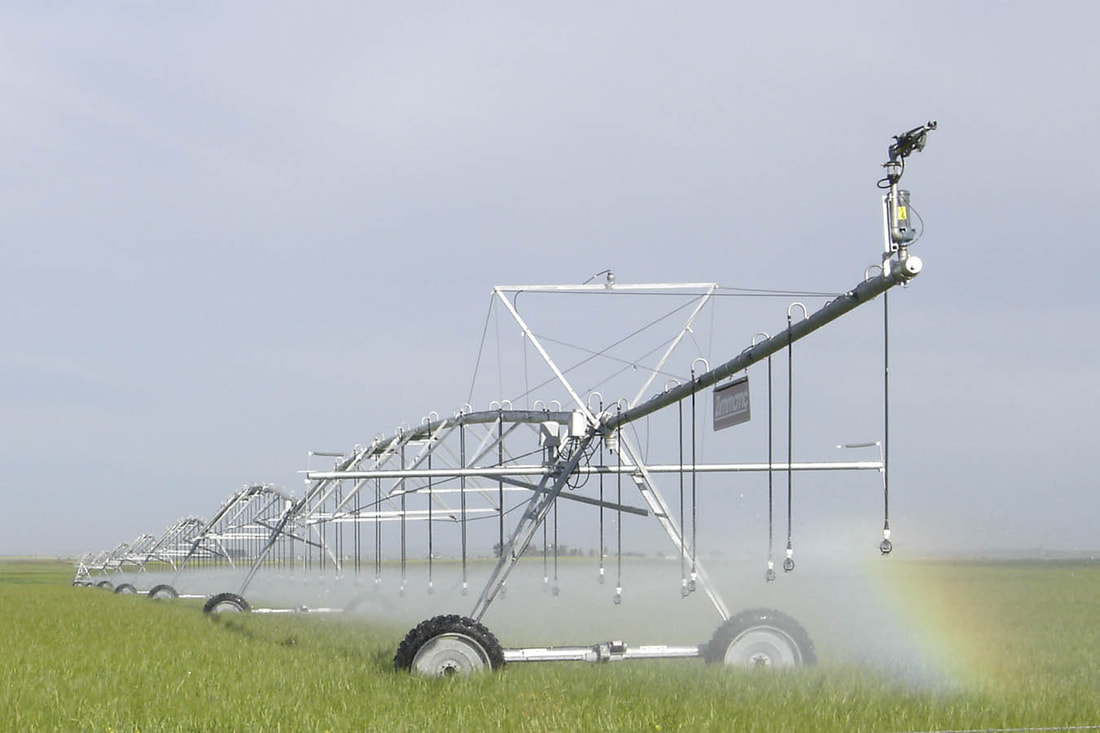 Watch your canola bins as I have heard it's a problem this season! While you are at it make sure your pulse bins haven't formed a cap on top as even dry pulses can do that. You don't want to auger or convey that rotted cap through your bin as you ship. 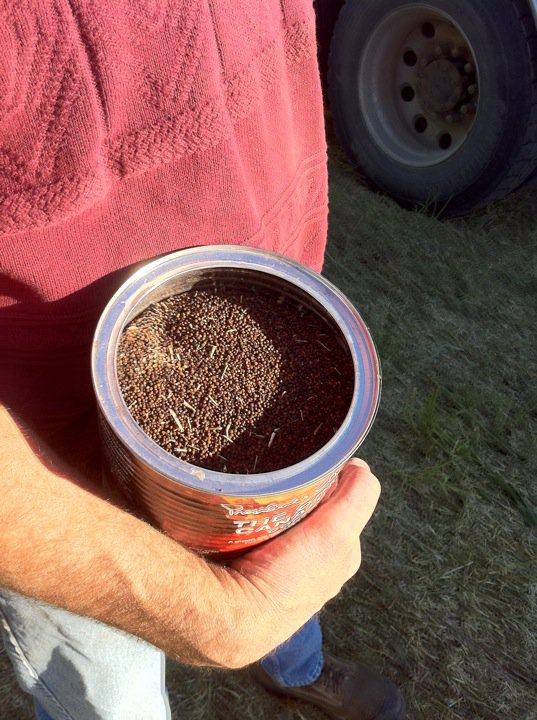 Scott Gilespe of Plants Dig Soil https://www.plantsdigsoil.com/ has started a WhatsApp channel where you can see links about realistic regenerative agriculture. I think the point is to showcase practical ways to adjust practices on your farm. Click here to join (you may need to click on your phone and have the WhatsApp app) https://whatsapp.com/channel/0029VaBofw37NoZxtgHSRl3S 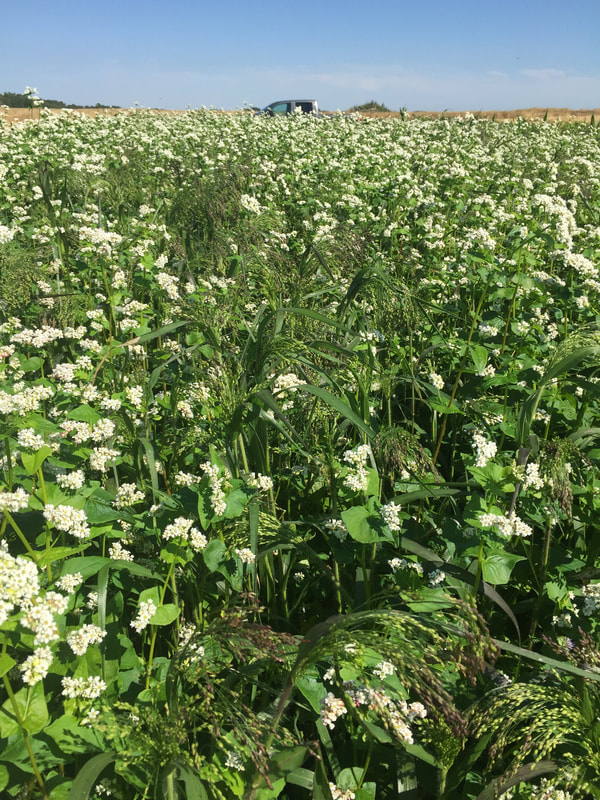 India has removed its import duty and volume restriction on yellow peas from Canada until March 31 and it is unknown if it will be extended. Product needs to be into India by that date. I think this should boost pea acres for next season. https://www.producer.com/news/india-is-back-in-business-on-peas/ 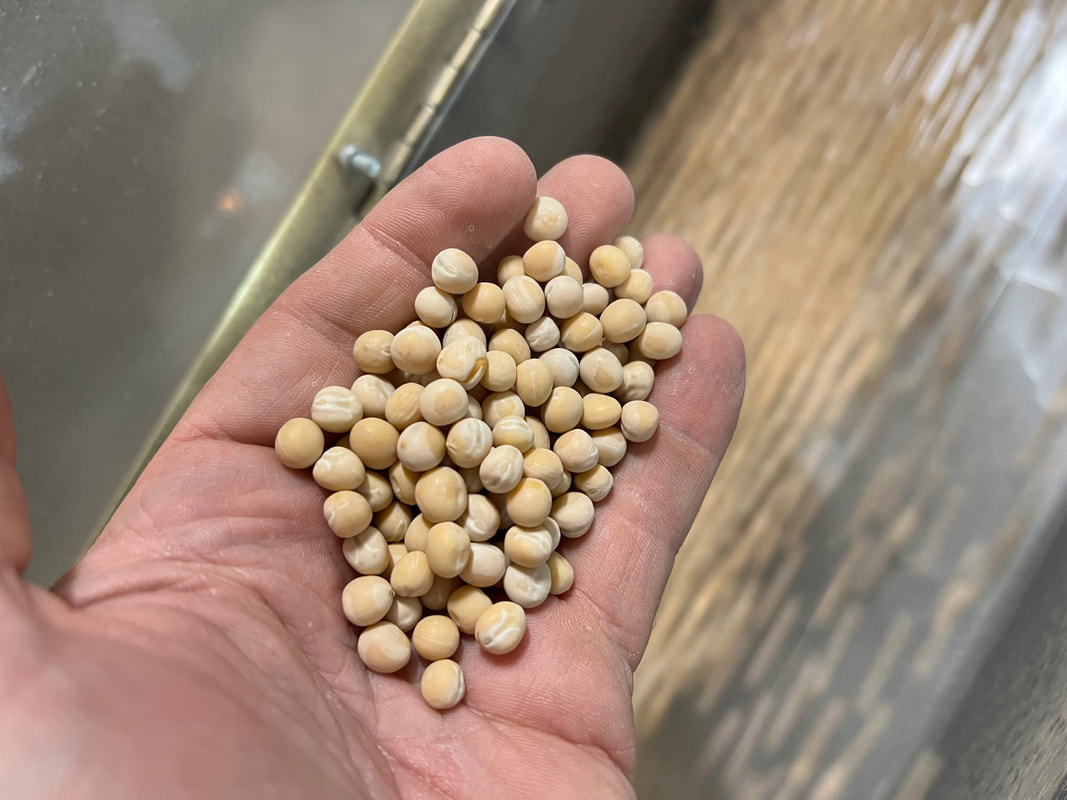 We had a great seed update a few weeks ago and all of the presentations are on YouTube for you to listen to or share! : https://www.youtube.com/@stampseeds/videos
Thanks to all the presenters and attendees for making it a success! MERRY CHIRSTMAS & HAPPY NEW YEAR
Our whole team wishes you a Merry Christmas & Happy New Year! We appreciate each and every one of you and really enjoy being part of your farms seeding decisions. We wish your family the best for 2024! December Hours We will be closed from Dec 23rd to Jan 1st inclusive and open Jan 2nd 2024. |
AuthorsBlair Balog - Seed Specialist at Stamp Seeds Archives
April 2024
Categories |
||
 RSS Feed